Setting up your pricing strategy
How to use the Strategy page: the baseline that underpins every price in the app. Labor rate, markup, channels, margin target, and overhead, in one place.
7 min read · Updated May 05 2026
The Strategy page is the baseline that every price in the app inherits from. Retail numbers, wholesale projections, channel pricing, the reverse calculator: all of it derives from the values you set here. Individual products can override these per-piece, but only if there's a baseline to override.
Set this once, set it carefully, then revisit twice a year. The defaults are reasonable; they aren't your business.
Labor rate
The hourly rate for in-house production work, set on the Strategy page. This is what flows into every piece's labor line when the work is in-house — bench work, stone setting, carving, polishing, or any other shop labor. External vendors carry their own billed rate on the labor library entry.
It's the rate the work commands, not your total income target. If you'd pay someone $60/hour to do the work, your in-house labor rate is $60/hour, even when you're the one doing it. Your time as the owner-operator gets compensated through markup and your margin target — not by inflating this number.
$50–$75/hour is a defensible starting range for production work done by a jeweler with 5+ years of experience. Below $40/hour, you're subsidizing your customers. Above $100/hour, you should have a clear reason: niche skill, signature technique, repair specialty.
→ Labor guide: how granular to make the library, generic vs. item-specific entries, and a naming convention so the library scales past the first twenty entries.
Markup
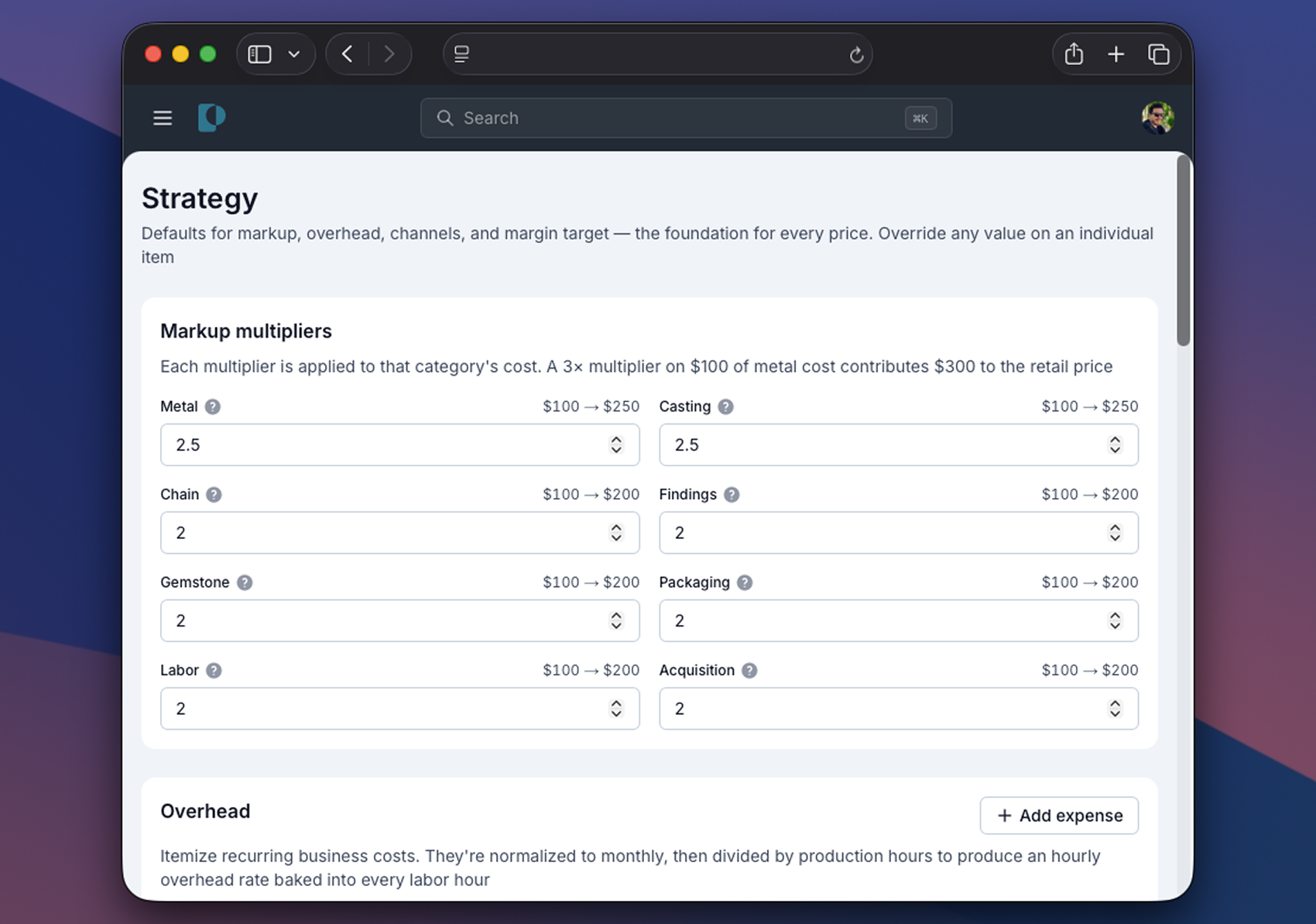
Markup is the multiplier between your cost to produce a piece and your retail price. A 2× markup on a piece that costs $100 to make produces a $200 retail price. A 2.5× markup produces $250.
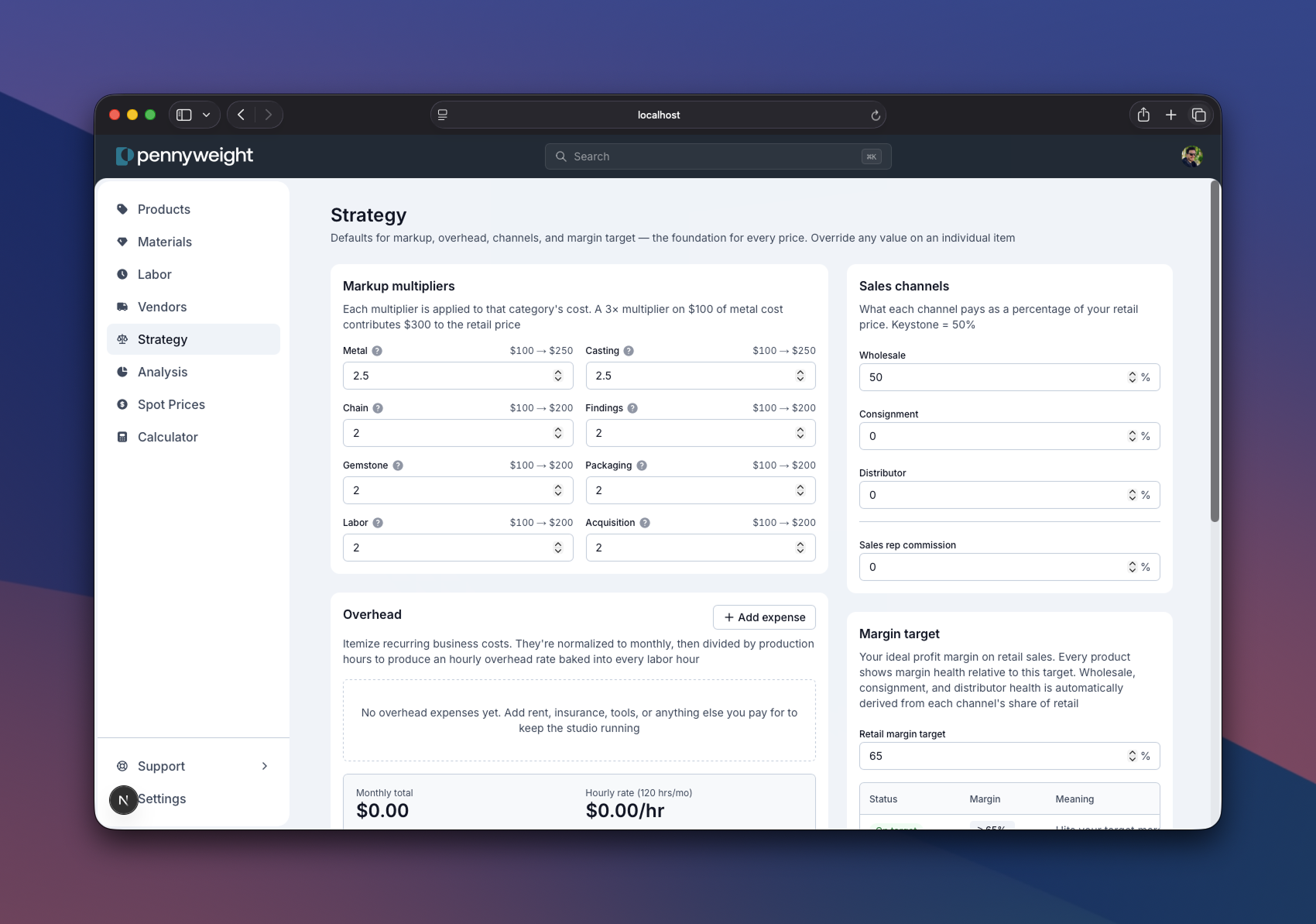
Pennyweight has a markup per material category, plus one for labor and one for acquisition cost (used when you buy finished pieces and resell them). Six material categories (metal, casting, chain, finding, gemstone, packaging), each with its own multiplier.
Why per-category?
Because different categories carry different risk and overhead. A 2.5× markup on metal is mid-range for fine jewelry. A 2× markup on packaging is absurd. You're not buying boxes to make a margin on boxes; you're buying them so customers can take pieces home. Most jewelers run packaging at 1× to 1.5×.
Gemstones and findings often warrant a higher markup, around 3×, because gemstones carry inventory risk, parcel-selection time, and assortment cost, and findings are pennies per unit where handling dominates the per-piece cost.
The defaults are:
- Metal, casting, chain: 2.5× (mid of the industry 2×–3× range)
- Finding: 3× (per-unit handling dominates the cost)
- Gemstone: 3× (inventory carry and parcel selection)
- Packaging: 1.5× (cost recovery with a touch of margin, not a profit center)
- Labor: 3× (in-house rate flows into your pocket; the additional × funds business margin since overhead is its own line)
- Acquisition: 2.5× (keystone+50% for resale of finished pieces)
These defaults are calibrated to land a typical piece near the 60% margin target (more on that below). Fine-tune any of them based on what your market supports.
Typical markup ranges by category
The defaults above are calibrated for a typical independent jeweler running a mixed catalog: production pieces, some fine work, some custom. They aren't universally right. Here's where the ranges actually sit, and what pulls a category up or down within them.
| Category | Typical range | Default | Why it sits there |
|---|---|---|---|
| Metal | 2×–3× | 2.5× | Mid of the industry range. Spot-linked, no inventory risk. Push to 3× on silver-heavy or fashion-priced lines. |
| Casting | 2×–3× | 2.5× | Treated like metal. Casting bill is your input cost. 3× recovers design/prep that doesn't fit a labor entry. |
| Chain | 2×–3× | 2.5× | Sold by weight, behaves like metal. Higher for finished/cut chain where inventory variety adds carry. |
| Finding | 2×–3× | 3× | Per-unit costs are pennies; 3× is the industry-common default because handling dominates the per-unit cost. |
| Gemstone | 2.5×–3× | 3× | Inventory carry, parcel selection, assortment risk, melee waste. Bracket pricing kicks in above ~$500 (see below). |
| Packaging | 1×–1.5× | 1.5× | Cost recovery, not a profit center. Some jewelers run 1× as transparent passthrough. |
| Labor | 2×–3× | 3× | Your in-house rate is your take-home; the additional × funds business margin. Overhead is its own line. |
| Acquisition | 2×–2.5× | 2.5× | Resale of finished pieces: keystone+50%. Above 2.5× is rare unless the piece is signed or scarce. |
Two things to read from this:
- Most categories cluster between 2.5× and 3×. That isn't a coincidence. Keystone (2×, or 50% margin) is the operating floor of the industry, and a handmade DTC business needs to live above it to clear a 60% margin once packaging and overhead drag the blend down. If you find yourself at 2× across the board, your business is structurally undermarked.
- Markup variance is a strategy choice, not noise. A jeweler running gemstones at 3.5× and packaging at 1× has decided where the margin lives. A jeweler running everything at 2.5× has made a different choice. Defensible, but it leaves nothing for the catalog to recover from on small or labor-light pieces.
Where the ranges shift by business model
The defaults assume a typical mix. Three patterns commonly justify pulling all of them in one direction:
- Production DTC at lower price points. Lean toward the high end (3× metal, 3× findings, 3× small gems) to clear your margin target despite small-ticket items. Overhead lands disproportionately on inexpensive pieces, and the defaults don't leave the room.
- Fine custom and one-of-a-kind. Lean toward the low end on materials (2× metal, 2.5× gem) and recover margin through labor at 3×–3.5×. The bill of materials is a smaller share of the retail; the work is what people are paying for.
- Wholesale-heavy lines. Keep materials closer to keystone (2×–2.5×) and resist pushing them up. Wholesale takes 50% of retail off the top, which already halves whatever multiplier you set; pieces that look strong at retail can break wholesale fast if you've stretched the markups.
The point isn't to hand you the right number. It's to show you the shape of the space, so the number you pick is deliberate. A 2.3× metal markup is fine; a 2.3× metal markup that you set because "it felt about right" is how catalogs drift below their own margin target.
Large gemstones (statement stones)
Stones above a certain price point don't get a fixed multiplier. They get bracket-based markup. The principle: a $5,000 sapphire cannot bear a 3× markup ($15,000 retail) because the market for that price point is thin and competitive. The bigger the stone, the smaller the multiplier.
Pennyweight's defaults:
- $0–$500: 3×
- $500–$750: 2.5×
- $750–$1,000: 2×
- $1,000–$1,500: 1.75×
- $1,500–$2,000: 1.5×
- $2,000+: 1.3×
These are tuned for a finished-piece retail market. If you sell loose stones, you'll want tighter brackets, typically 1.2× to 1.5× across the board.
There's also a profit-split setting for non-retail channels (wholesale, distributor, custom): how much of the gem's profit stays with you vs. goes to the store. The default is 50/50. This exists because at wholesale, a strict keystone on a large gem leaves the store with no margin. The 50/50 split shares the upside more equitably.
Overhead
Overhead is your fixed monthly business costs (studio rent, insurance, software, tools, utilities) divided across your production hours to produce a per-hour rate. Pennyweight adds this rate to every in-house labor hour, so the price of a piece reflects your time plus the cost of having a business at all.
You set overhead in two parts:
- Monthly expenses. List each one with its frequency (monthly, quarterly, annually). Pennyweight normalizes them to a monthly figure and sums.
- Production hours per month. Typically 80–120 for a solo bench jeweler. This is the denominator. Total monthly expenses ÷ production hours = overhead rate per hour.
If your overhead is $2,400/month and you bill 100 production hours, your overhead rate is $24/hour. Every in-house labor hour on every piece adds $24 to the cost.
Be honest about production hours. If you spend 30 hours a week at the bench and 10 hours doing admin, your production hours are 30 × 4 = 120, not 160. Overstating production hours understates overhead, which understates your prices.
One-time costs: molds, prototypes, development
Some costs aren't per-piece and aren't ongoing overhead either. A casting mold runs $500–$2,000. A CAD development cycle for a custom piece can be a full day of bench time before any production starts. A prototype run that won't be sold is real money out the door. These costs need to be recovered across the units you'll actually produce, and most jewelers either eat them silently or guess.
A few reasonable approaches:
- Amortize over an expected run. Decide "I'll cast 50 of these" → $800 mold ÷ 50 = $16/unit. Add a fixed-fee labor line called "Mold amortization" on the item. Simple, but you're guessing the run size: undershoot and you over-recover, overshoot and you eat the difference.
- Front-load into the first batch. Spread the full cost across the first 10–20 units, then remove the line item once you've recovered. Pricing settles after the initial run. Works for small runs and one-off custom commissions.
- Absorb into overhead. Treat mold and dev costs as studio overhead. Keeps item pricing clean, but your overhead rate has to actually cover them, and pieces that don't use molds end up subsidizing pieces that do.
- Hybrid: per-unit line + overhead. Modest "development recovery" labor line on the item itself, plus a small overhead bump to catch the tail. Belt and suspenders.
The shippable approach in Pennyweight today is a labor library entry like "Mold recovery, Ring series A" with a fixed fee per unit, applied to every item in that series and removed once the mold is paid off. Make the amortization explicit and visible. Opaque cost recovery is what turns into silent margin loss six months later.
Pieces that come in multiple sizes
Rings come in sizes 4 to 10. Chains come in 16, 18, 20, 22 inches. Bangles come in small / medium / large. Metal weight scales with the size, and so do cost and retail. The difference can be material: a size 10 18K ring uses roughly 26% more gold than a size 5, and a 22-inch chain uses 22% more gold than an 18-inch chain in the same gauge.
The trap is to model every size as a separate item. A line of 12 ring SKUs becomes 144 items in your catalog, every markup edit is N×12 places to change, and you spend more time grooming variants than designing pieces.
The recommendation: price each piece in one reference size and publish that price across the line. For most independent jewelers this is already how it works in practice. There's a "size 7 base" with a flat "+$X per size up" surcharge handled at the time of order, not on the price tag. The catalog stays clean, the math is approximate but defensible (~15% off at the extremes for rings), and you stop maintaining a dozen versions of the same design.
Pick the reference size deliberately
- Rings: size 7. Center of the women's range and a defensible average. Some brands use size 6 if their customer skews smaller. The point is to publish one size as the price and resize from there.
- Chains: 18 inches. The most-sold length for women's necklaces. Price the chain at 18", then
offer 16" / 20" / 22" with a small per-inch adder. The math is
spot $/g × g/inch × markup. Pennyweight'schainmaterial category multiplies cleanly because chains are sold by weight per length to begin with. - Bangles: medium. Or "fits a 7-inch wrist," whichever your customer speaks. Same principle: one size sets the price.
When precision matters more than continuity
If your line sits at a price point where ±$150 of metal cost across sizes changes the conversation (heavy gold pieces, platinum, large diameters), publish a per-size price chart on the listing rather than a single number. Circumference is linear in ring size and length is linear in chain inches, so the math is straightforward; show the size 9 price before the customer asks. This is rare for production work and common at the fine-jewelry end. Pick based on where your line lives.
Why this is a strategy decision, not a feature
You're not pricing a ring; you're pricing a design. The design has a representative size. Every other size is a variation of the design, priced the way the bench treats it: design + metal-weight delta + sometimes extra labor for the resize. Publishing one number per design matches what you actually sell, the design itself, instead of the variations around it.
Margin target
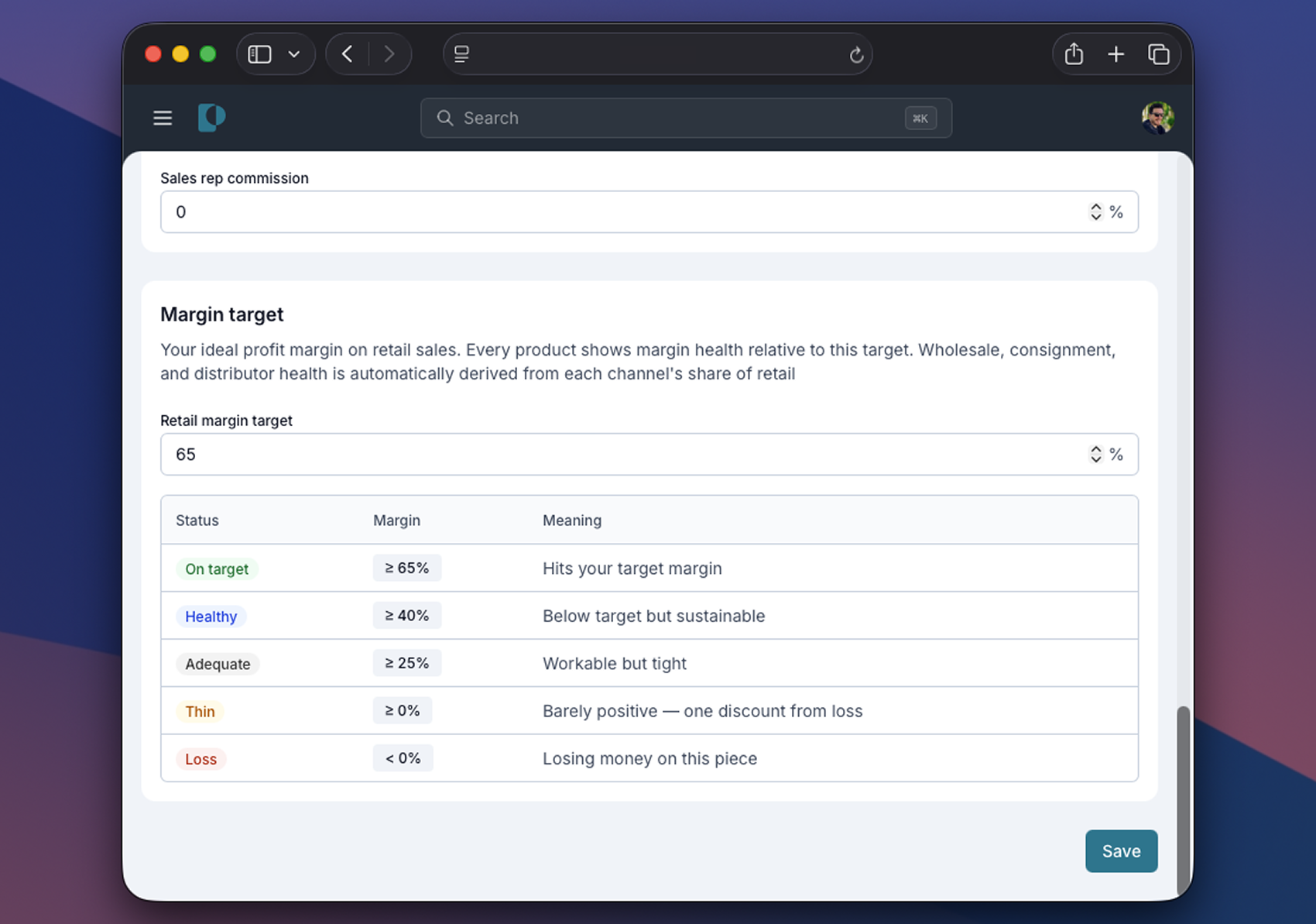
The margin target is the share of retail you want every piece in your catalog to keep as profit
after costs. The math is (retail − cost) ÷ retail. A piece that costs $160 to make and retails at
$400 lands at a 60% margin: (400 − 160) ÷ 400.
The default is 60%. That's a defensible bar for a direct-to-consumer jewelry business: it sits mid-range of the 50–70% gross-margin band the industry actually operates in, leaves room to absorb discounts and slow movers, and, importantly, is achievable with the default per-category multipliers. Most independent makers should sit between 55% and 70%; below 50% you're running thin enough that one bad month hurts, above 70% your prices are starting to outrun your market.
How the target gets used
The margin target is a measuring stick, not a hard cap. Pennyweight won't stop you from selling a piece below it. What the target does is flag every piece that falls short on the Analysis page, so you find out at the catalog level rather than one wholesale invoice at a time. Pieces above the target read green; pieces below it read red, with the actual margin shown next to the bar so you know how far short.
That separation matters. The pricing engine respects the components and markups you set, even when that produces a piece that misses your target. The target is feedback about the catalog, not a constraint on the math.
Why pieces miss the target
A few patterns account for almost every miss:
- Labor-heavy, metal-light pieces. A finely-fabricated silver brooch with 4 hours of bench time has very little metal cost and a lot of labor cost. Even at a 3× labor markup, the overhead added to each labor hour passes through at 1×, which can pull a labor-dominated piece below the 60% target. Either the labor markup needs to come up or the retail needs to come up.
- Small pieces dragged down by overhead. A simple sterling pendant might cost $18 in materials and 20 minutes of labor. The fixed overhead-per-hour line lands disproportionately on small pieces and pulls the margin down. Often the right move is a small minimum-price floor on inexpensive pieces, not a markup change.
- Pieces with one big component you're not marking up enough. A statement gemstone with the bracket-based markup at 1.3× is structurally below your blended target. That's intentional (the market won't bear higher) but it means a stone-heavy piece can pull the catalog average down.
Margin and markup have to agree
A 60% margin target with 2× markups across the board doesn't work; the math fights itself. A quick alignment chart:
- 2× markup → 50% margin
- 2.5× markup → 60% margin
- 3× markup → 67% margin
- 3.5× markup → 71% margin
If your target is 60%, your blended markup needs to land near 2.5× on average. Per-category markups can sit on either side of that (packaging at 1.5× alongside gemstones at 3×) as long as the overall mix clears the bar. Pennyweight's defaults (2.5× metals, 3× findings/gem/labor, 1.5× packaging) are calibrated to land a typical piece in the 57–62% range so the default target is reachable without per-piece tuning.
What lives outside the target
- Channels have their own floors. Wholesale, consignment, and distributor pricing each have separate minimum margins, looser than retail because keystone math is structurally tighter. You can't accidentally configure a wholesale channel that loses money. Pennyweight warns you on the channel pricing card.
- The target is shop-wide. There's one number, and every piece is measured against it. A category that genuinely runs at a lower margin (custom commissions priced for the relationship, high-volume holiday ornaments) is a per-piece judgment call, not a setting.
When to revisit
Twice a year is enough for most jewelers. Set a calendar reminder for January and July.
The exceptions are:
- Your supplier prices changed materially. New refiner, new findings vendor, new gem dealer. The materials library reprices automatically, but if your typical metal cost has shifted, you may want to rebalance markups.
- You added a new sales channel. Picked up a new retailer, started consigning at a gallery. The channel percentages need to be set before the first wholesale invoice goes out.
- You raised your labor rate. Most jewelers underbill themselves for years. When you finally raise the rate, audit your markups too. The price increase needs to feel intentional, not like a labor-rate edit accidentally pushed everything up 8%.
You're done. Now look at a real piece in your catalog and see what the engine thinks it should sell for.
Sign up to read the rest of this guide
The rest of this guide (typical markup ranges by category, gem-bracket numbers, the overhead formula, mold amortization patterns, multi-size pricing strategy, and the margin/markup alignment chart) is included free with any Pennyweight account.
Where to go from here
- Spot prices: the mental model behind why Pennyweight stores components, not prices. The strategy levers above only make sense once the cost side is computed live.
- Channels: the channel percentages that sit on top of your retail strategy. Set these before your first wholesale invoice goes out.
- Materials: naming conventions and the library/instance distinction. A clean materials library is what keeps strategy edits propagating cleanly to every piece.